Complete Guide to Multilingual Marketing for European Businesses
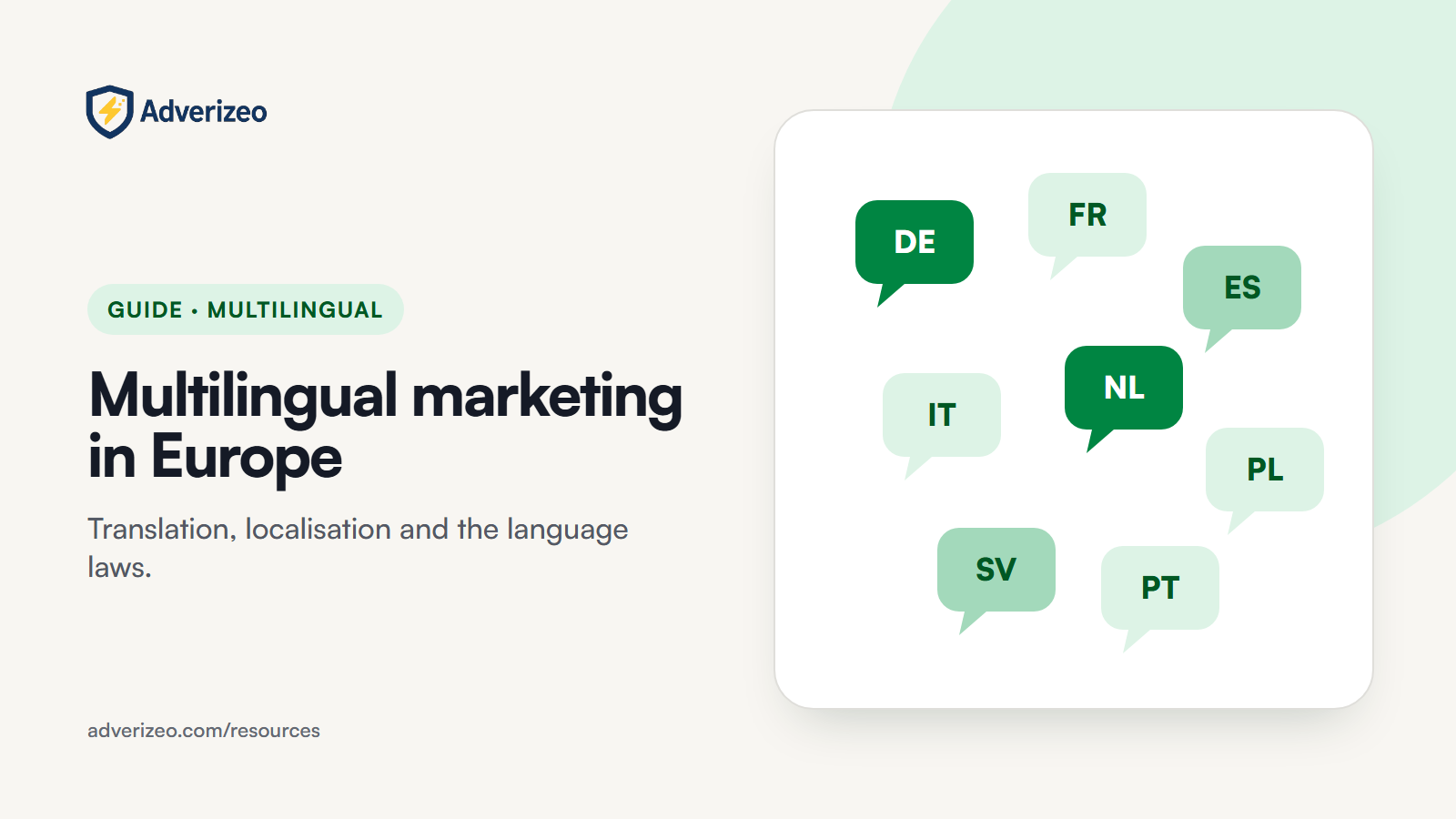
How to plan multilingual marketing across Europe: translation vs transcreation, language laws in France, Poland and Catalonia, prior-price rules in six countries, and platform language settings.
Team Adverizeo18 min read
On this page
- 1. Why language matters: what the evidence actually says
- 2. Translation, localisation and transcreation
- 3. Which markets need their own language ads
- 4. Legal language requirements for advertising
- France: the Loi Toubon
- Poland: the Polish Language Act
- Spain: regional language rights in Catalonia
- Belgium and Switzerland
- Consent and privacy texts everywhere
- 5. Consumer-law differences in ad claims: DE, FR, IT, ES, NL, PL
- The shared EU base
- Price reductions: the 30-day prior-price rule
- Green claims: new EU rules from 27 September 2026
- 6. Platform language targeting settings (as of October 2026)
- 7. Quality checks before publishing
- 8. Common mistakes
- 9. What to do this week
- How Adverizeo fits in
Multilingual marketing in Europe means running ads, landing pages and consent flows that work in each market's own language and follow that market's own rules. It is not one English campaign with translations attached at the end. This guide covers when to translate, localise or transcreate, which countries have legal language rules for advertising, how price and claim rules differ between Germany, France, Italy, Spain, the Netherlands and Poland, and how language targeting works on Google, Meta and LinkedIn as of October 2026.
1. Why language matters: what the evidence actually says
The European Union has 24 official languages across 27 member states. That alone does not tell you how people behave, so it helps to look at the one large EU-wide survey that asked the question directly.
The European Commission's Flash Eurobarometer 313, "User language preferences online", interviewed 13,752 internet users aged 15 and over in all member states between 28 January and 1 February 2011. Its main findings:
- 9 in 10 respondents said that, when given a choice of languages, they always visited a website in their own language.
- Only a slim majority (53%) said they would accept an English version of a website if it was not available in their own language.
- 44% thought they missed interesting information because websites were not in a language they understood.
- Agreement with "I always visit a website in my own language" was highest in Poland (95%). Outside Malta and Luxembourg it was above 70% in every member state, and in Luxembourg it was 58%. Willingness to use an English site was highest in Malta (97%) and Cyprus (90%).
Two honest caveats. The survey is from 2011 and covered internet users only, so treat it as a direction rather than a current benchmark. And it measured browsing preferences, not purchases: older marketing articles sometimes claim the same survey proves people "won't buy" in a foreign language, but that finding is not in its summary. What the data does support is simple: given a choice, most people pick their own language, and close to half are not ready to fall back to English.
2. Translation, localisation and transcreation
These three words get used loosely. For planning and budgeting it helps to keep them apart:
- Translation carries the exact meaning from one language into another. It is the right method when precision matters more than persuasion.
- Localisation translates and then adapts the details that change by market: currency and number formats, dates, units, address formats, local terms for the same product, and the formal or informal way of addressing the reader.
- Transcreation starts from the brief, not the sentence. A native writer recreates the idea, tone and call to action so it lands the way the original intended. For ad headlines this is usually the right method, because a literal translation of a pun or hook rarely works.
| Asset | Method | Why |
|---|---|---|
| Privacy notice, cookie banner, terms, legal footers | Translation, reviewed | The meaning must stay exact. A nice-sounding paraphrase can change what people agreed to. |
| Product facts, specs, delivery and returns information | Localisation | Formats, units and prices must match local expectations and consumer rules. |
| Ad headlines, hooks, slogans, calls to action | Transcreation | Persuasion depends on idiom, rhythm and register, which do not survive word for word. |
| Search keywords | Fresh local keyword research | People in each market search with their own words, not with your translated ones. |
| Price-reduction claims ("-20%", "was / now") | Localisation plus legal check | The prior-price rules in section 5 are national laws with local details. |
| Brand and product names | Usually kept | Check the name does not carry an unwanted meaning in the target language. |
One practical point is easy to miss: translated text can come out longer than the source. Check every headline and description against the channel's character limit after translation, not before. The same goes for the form of address (for example Sie or du in German, vous or tu in French): choose one per brand and market and write it into your style guide, or different writers will mix them.
3. Which markets need their own language ads
The safe default for consumer advertising is one language version per market, written for that market. English-only campaigns can be a reasonable test for some international B2B or tech audiences, and the Eurobarometer data suggests English is better accepted in places like Malta and Cyprus. In most markets, though, an English ad asks a large share of people to work harder to understand you.
Several countries need more than one version because they have more than one language community:
- Belgium has Dutch-, French- and German-speaking language regions, and Brussels is officially bilingual (Dutch and French).
- Switzerland (not an EU member) has four national languages under Article 4 of its Federal Constitution: German, French, Italian and Romansh. Campaigns are normally planned per language region.
- Spain has co-official regional languages. In Catalonia, Catalan has specific consumer-law protections (see section 4).
The table below summarises the markets this guide covers. The legal column lists only rules we checked against the official text or an official body.
| Market | Language versions to plan | Legal language rule | Prior-price law for discount ads |
|---|---|---|---|
| France | French | Loi Toubon: French is mandatory in advertising | Consumer Code, Art. L112-1-1 |
| Germany | German | No general advertising language law found | Price Indication Ordinance (PAngV), § 11 |
| Italy | Italian | No general advertising language law found | Consumer Code, Art. 17-bis |
| Spain | Spanish; Catalan for Catalonia; plan other co-official languages by region | Catalonia: consumers may receive invitations to purchase in Catalan | Law 7/1996 on retail trade, Art. 20 |
| Netherlands | Dutch | No general advertising language law found | Price Indication Decree, Art. 5a |
| Poland | Polish | Polish Language Act: Polish required for consumer information, including in advertising | Price Information Act 2014, Art. 4 |
| Belgium | Dutch and French; German for the German-speaking region | Language use free in principle; mandatory labelling must be understandable in the language region | Belgian national rules (check before launch) |
| Switzerland (non-EU) | German, French, Italian by region | Swiss law, not EU directives; check product-specific rules | Swiss rules, not the EU Omnibus Directive |
4. Legal language requirements for advertising
There is no single EU rule that says which language an ad must use. A few national laws do, and they matter more than most marketers expect.
France: the Loi Toubon
Article 2 of Law No. 94-665 of 4 August 1994 makes French mandatory for the designation, offer and presentation of goods and services, instructions, warranty terms and invoices, and for all written, spoken or audiovisual advertising. Other languages are allowed alongside French, but Article 4 requires the French version to be as legible, audible or intelligible as the foreign-language version. Enforcement runs through the consumer-protection agents of the Consumer Code.
In practice: an English tagline on a French ad needs a French translation that is just as visible, not a small footnote. This applies to display banners, social ads and video voice-overs aimed at the French market.
Poland: the Polish Language Act
The Act of 7 October 1999 on the Polish language requires Polish in dealings with consumers in Poland (Art. 7). Article 7a lists what this covers: names of goods and services, offers, warranty terms, invoices and receipts, consumer warnings and information required by other laws, instructions, and information about the properties of goods and services. The act states that this last obligation also applies to advertising. Foreign-language descriptions and offers must come with a Polish version at the same time. Article 11 exempts proper names, trademarks, trade names, designations of origin and customary scientific and technical terms. Using only a foreign language where Polish is required is punishable by a fine (Art. 15).
Spain: regional language rights in Catalonia
Catalonia's Consumer Code (Law 22/2010, Art. 128-1) gives consumers the right to be served orally and in writing in the official language they choose, and the right to receive in Catalan "invitations to purchase", fixed information, contractual documents, quotes and invoices. Catalan Law 1/1998 on language policy (Art. 32) also requires fixed signage and service-offer documents for consumers to be at least in Catalan, with an exception for brands and trade names. Under EU consumer law, an "invitation to purchase" is a commercial communication that shows the product's characteristics and price in a way that lets the consumer buy, so a price-led ad aimed at consumers in Catalonia can fall into that category. Spain's Constitutional Court upheld Article 128-1 in judgment STC 88/2017 of 4 July 2017, but only on the reading that it cannot exclude Spanish: consumers keep the right to receive the same documents and information in Spanish as well. If Catalonia is a real market for you, plan a Catalan version.
Belgium and Switzerland
Belgium's Constitution (Art. 30) treats language use as free in principle. Mandatory labelling, instructions and warranty information, however, must be in a language the average consumer understands, taking into account the language region where the product is sold (Book VI of the Code of Economic Law). For ads, the practical approach is to choose the language by region rather than by country. Switzerland sits outside the EU, so EU directives such as the Omnibus Directive do not apply there directly; check Swiss rules for your product category before you launch.
Consent and privacy texts everywhere
The GDPR requires a consent request to use "clear and plain language" (Art. 7(2)) and privacy information to be concise, intelligible and in clear and plain language (Art. 12(1)). A cookie banner or privacy notice in a language the visitor does not read is hard to defend as clear and plain. The common gap is a fully localised ad that leads to a landing page whose consent banner is still in English. Our cookie consent implementation guide and the practical cookie consent post cover the banner itself, and the GDPR-compliant marketing guide covers the wider rules.
5. Consumer-law differences in ad claims: DE, FR, IT, ES, NL, PL
The shared EU base
All six countries apply the Unfair Commercial Practices Directive (2005/29/EC), which bans misleading actions and omissions. For an invitation to purchase, it treats as material: the main characteristics of the product, the trader's identity and address, and the price including taxes and any extra delivery charges. If a consumer ad shows a price, it should be the full price.
Comparative advertising is lawful in all six markets when it meets the conditions in Article 4 of Directive 2006/114/EC. The comparison must not be misleading; it must compare goods or services meeting the same needs; it must objectively compare material, relevant, verifiable and representative features (price can be one); and it must not denigrate a competitor, take unfair advantage of their brand's reputation, present goods as imitations of a protected brand, or create confusion. National courts and regulators apply these tests case by case, so keep the evidence behind every comparison on file before the ad runs.
Price reductions: the 30-day prior-price rule
The Omnibus Directive (EU) 2019/2161 added Article 6a to the Price Indication Directive. Any announcement of a price reduction must show the prior price, defined as the lowest price the trader applied in a period of at least 30 days before the reduction. Member states had to apply it from 28 May 2022 and could set their own rules for perishable goods, products on the market for less than 30 days, and progressively increasing reductions.
On 26 September 2024, the Court of Justice ruled in Case C-330/23 (Aldi Süd) that a reduction announced as a percentage, or through a promotional statement stressing the advantageous price, must be calculated from that 30-day lowest price. In the case itself, the brochure calculated "-23%" from the price charged just before the offer, while the lowest price of the previous 30 days was the same as the "reduced" price. Showing the 30-day lowest price somewhere in the ad while calculating the percentage from a higher, more recent price does not meet the rule.
Each country wrote the rule into its own law, with different options:
| Country | Law | Notable national details |
|---|---|---|
| Germany | PAngV § 11 | Lowest price of the last 30 days. Progressive reductions may refer to the price before the first step. Exceptions for individual price reductions and for perishable goods reduced because they are about to spoil or expire, if this is made clear. |
| France | Consumer Code, Art. L112-1-1 | Lowest price of the previous 30 days. Successive reductions refer to the price before the first one. Perishable goods at risk of rapid deterioration are excluded, and the rule does not cover comparisons with other traders' prices. |
| Italy | Consumer Code, Art. 17-bis | Lowest price applied to consumers in the previous 30 days. Perishable agricultural and food products are excluded. For products on the market under 30 days, state the period used. "Launch prices" followed by announced increases fall outside the article. Breaches of the article are fined under the retail-trade rules (Legislative Decree 114/1998, Art. 22(3)); a misleading reduction can also be pursued by the competition authority (AGCM) as an unfair commercial practice, with fines from €5,000 to €10 million. |
| Spain | Law 7/1996, Art. 20 | Show the prior price with the reduced price; the prior price is the lowest applied to identical products in the previous 30 days. Not required for items offered for sale for the first time. Prices cut to reduce food waste on products close to their use-by or best-before date are left out when working out the prior price. |
| Netherlands | Price Indication Decree, Art. 5a (in force 1 January 2023) | Lowest price of at least 30 days. For perishable product categories set by ministerial regulation, the price applied just before the reduction may be shown. For progressively increased reductions, the 30-day lowest price before the first reduction may be used for up to three calendar months. For products on the market under 30 days, the lowest price over a period the seller states. |
| Poland | Price Information Act 2014, Art. 4 | Lowest price of the 30 days before the reduction; for products offered under 30 days, the lowest price since sales began. The rules expressly apply to advertising that states a price. Fines up to PLN 20,000, or up to PLN 40,000 after at least three breaches within 12 months. |
For a multilingual campaign this has one big consequence: a "was / now" or "-30%" ad cannot simply be translated. Each market's version needs a prior price that is correct under that market's rule on the date the ad runs.
Green claims: new EU rules from 27 September 2026
Directive (EU) 2024/825 on empowering consumers for the green transition required member states to apply its rules from 27 September 2026. It adds to the list of practices that are always unfair: generic environmental claims where the trader cannot show recognised excellent environmental performance relevant to the claim; environmental claims about a whole product or business when they only concern one aspect; and claims that a product has a neutral, reduced or positive greenhouse-gas impact based on offsetting. These rules are new, so check how your target countries transposed them, and review translated green wording carefully, because a precise English claim can turn into a generic one in translation.
6. Platform language targeting settings (as of October 2026)
| Platform | How language works now | What to do |
|---|---|---|
| Google Ads, Search | Starting in September 2026, Google is removing the campaign-level language setting for Search campaigns. Search ads are matched automatically based on the language of the ads, with priority for ads in the language of the user's search term. | Write each ad group fully in one language. Do not mix languages in one ad group. Keep the landing page in the same language. |
| Google Ads, Performance Max | From the same change, the campaign language setting no longer applies to ads on the Google Search Network, but still applies to other channels such as YouTube, Display, Discover and Gmail. | Keep language settings correct for the non-Search channels and keep assets in one language per campaign or asset group. |
| Meta (Facebook, Instagram) | You can add several language versions to one ad (dynamic language optimisation). Meta picks the version for each person using signals such as their interface language and languages they have engaged with. | Have each language version written or reviewed by a native speaker. Check that location targeting matches the languages you supplied. |
| Profile language is required. English targets all members in the location; any other language reaches only members whose profile language matches. The language cannot be changed after an ad is added. | Members who keep an English profile will not see a French- or German-language ad set, so test an English ad set alongside the local one in B2B markets. |
Google documents the Search change in its About language targeting help page. If you built campaigns on the old setting, the practical change is that your copy now does the targeting: a German ad in a campaign meant for Austria will be matched as German, so the ad text has to be right for the audience you actually want. For the privacy side of each platform, see our posts on Google Ads GDPR settings, Facebook and Instagram ads and LinkedIn ads, and the channel guides on Google Ads, Meta and Instagram and LinkedIn for B2B. Online shops running discount ads in several countries will also find the e-commerce advertising guide useful.
7. Quality checks before publishing
Run these checks on the final copy in each language, not on the English draft:
- Native review. A native speaker who knows the market reads the final ad, landing page and banner together.
- Length. Every headline and description fits the channel's limits after translation.
- Glossary and voice. Product terms match your approved glossary, and the form of address matches your style guide.
- Prices. Local currency format, consumer prices including taxes, and a correct prior price for any discount under that country's rule.
- Claims. Superlatives, comparisons and environmental wording are backed by evidence you can produce, and no generic green claim crept in during translation.
- Legal language. French version as visible as any foreign text in France; Polish version of product information in Poland; Catalan version where you target consumers in Catalonia.
- Consent path. Landing page, cookie banner and privacy notice are in the same language as the ad.
- Keywords. Search keywords come from local research, not from translating your English list.
- Names. Brand, product and campaign names are checked for unwanted meanings.
- Platform setup. One language per ad group on Google Search; language versions mapped correctly on Meta; LinkedIn profile language chosen on purpose.
8. Common mistakes
- Translating the English headline word for word instead of transcreating it from the brief.
- Localising the ad but leaving the consent banner and privacy notice in one default language.
- Copying a "-30%" claim across markets without checking each country's 30-day prior price.
- Putting an English slogan on French ads without an equally visible French version.
- Translating keyword lists instead of researching how each market searches.
- Running one Belgian campaign in one language, or one Swiss campaign for all regions.
- Still relying on Google's old campaign language setting for Search after September 2026.
- Selecting a non-English profile language on LinkedIn without realising it excludes members with English profiles.
- Letting each market's freelancer choose their own terms and tone, so the brand sounds different in every country.
9. What to do this week
- List every market you advertise in and the language versions each one needs, using the market table above.
- Check that every landing page, cookie banner and privacy notice exists in the same languages as your ads.
- Pull all live discount ads and confirm the prior price for each country.
- Audit Google Search campaigns for mixed-language ad groups now that the campaign language setting is being removed.
- Write a one-page glossary and style guide per language: key product terms, form of address, banned words.
- Book a native reviewer for each language before the next campaign, not after it launches.
How Adverizeo fits in
Adverizeo's Multi-Language Hub writes ad copy in 20+ languages (22 of the 24 EU languages plus Norwegian), within each channel's format limits, and Brand Voice helps keep the tone consistent across markets. Every text ad gets a compliance score from 0 to 100 with suggestions and country rules for EU locales; it is a risk check, not a legal guarantee, so native review still matters. You can try the free GDPR ad checker without an account, or start on the free plan.
This guide is general information, not legal advice.