Complete Guide to Advertising Claims in the EU: What You Can and Cannot Say
Plain-English guide to advertising claims in the EU: misleading ads, the blacklist, superlatives, comparisons, price cuts, urgency, health, green, reviews, job ads and alcohol, with safer rewrites.
Team Adverizeo18 min read
On this page
- 1. How EU advertising law fits together
- 2. Summary table: every topic at a glance
- 3. Misleading actions and omissions
- 4. The Annex I blacklist: what small businesses actually trip over
- 5. Superlatives: "best", "cheapest", "fastest"
- 6. Comparative advertising
- 7. Price reductions and the 30-day prior-price rule
- 8. Urgency and scarcity
- 9. Health claims
- Food, drinks and food supplements
- Cosmetics
- Services: clinics, therapists, trainers
- 10. Green claims (short version)
- 11. Reviews, testimonials and influencers
- 12. Job ads and equal treatment
- 13. Alcohol
- 14. A short note on the US
- 15. Common mistakes
- 16. Checklist before you publish
- Where Adverizeo fits
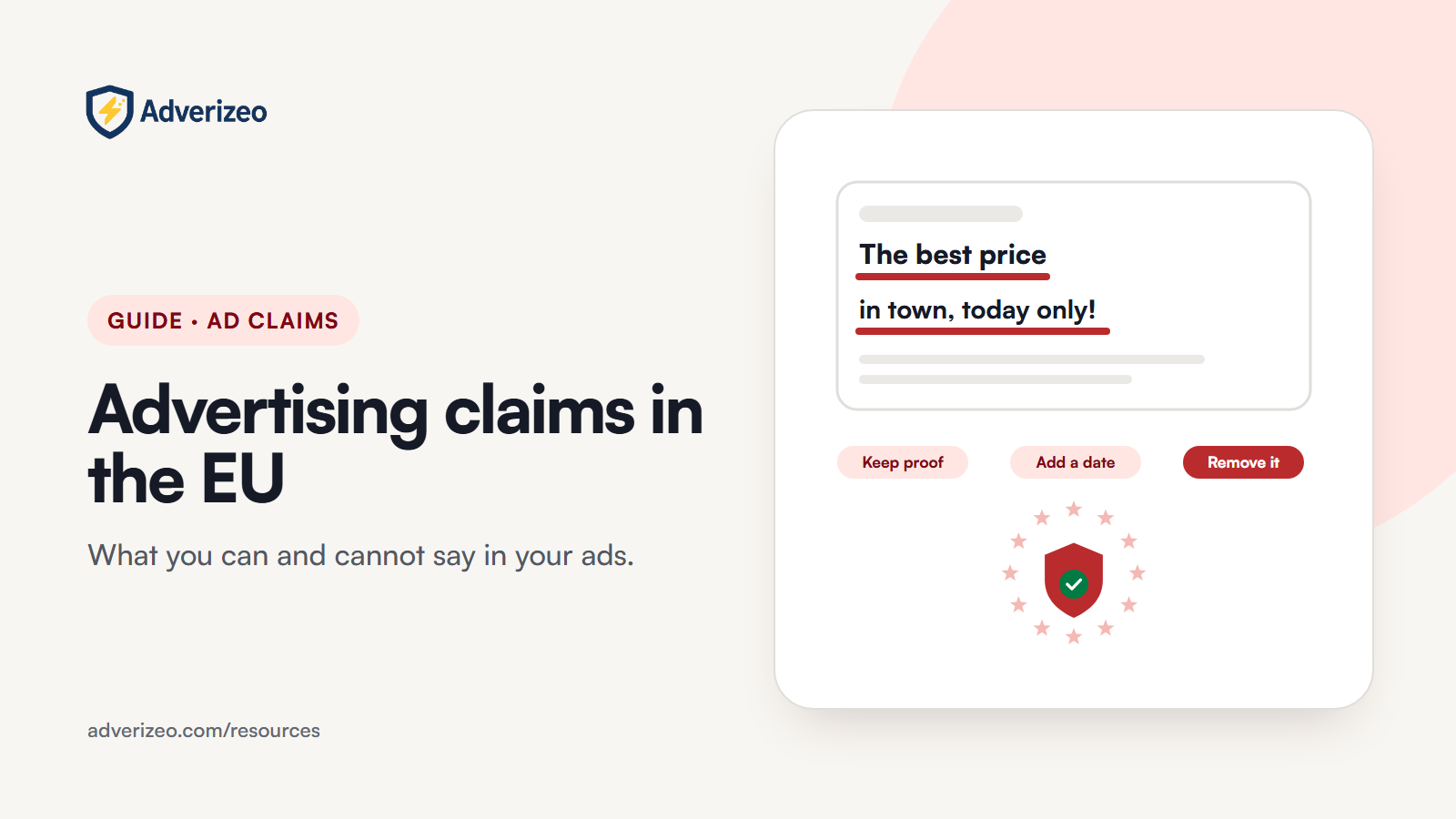
Advertising claims in the EU are judged by one simple test: would the line mislead an ordinary customer, and can you prove it if a regulator or competitor asks? Most rules come from the Unfair Commercial Practices Directive (UCPD), plus specific laws for comparisons, price cuts, food, cosmetics, environmental claims and job ads. This guide explains, topic by topic, what is banned outright, what is fine only with proof, and how to rewrite risky lines, as of November 2026.
1. How EU advertising law fits together
- Ads to consumers: the Unfair Commercial Practices Directive 2005/29/EC. Article 6 bans misleading actions, Article 7 misleading omissions, and Annex I lists practices that are unfair in all circumstances, without any case-by-case test (Article 5(5)).
- Ads to businesses, and comparisons with competitors: Directive 2006/114/EC, which protects traders against misleading advertising and sets the conditions for comparative advertising (Article 1).
- Sector rules on top: price reductions, food, cosmetics, audiovisual alcohol ads and more. Where a specific EU rule conflicts with the UCPD on a specific aspect, it wins (UCPD Article 3(4)).
- National law: directives apply through national law. The UCPD leaves room for national professional rules for regulated professions such as lawyers and doctors (Article 3(8)) and for national health and safety rules, for example on alcohol (Article 3(3) and recital 9). Job ads are governed by the equal-treatment directives, not the UCPD.
You carry the burden of proof: authorities can require evidence for factual claims and treat a claim as inaccurate if you cannot provide it (UCPD Article 12; Directive 2006/114/EC Article 7). Fines can be serious: since the Omnibus Directive (EU) 2019/2161, in coordinated cross-border enforcement national law must allow maximum fines of at least 4% of annual turnover in the Member States concerned, or at least EUR 2 million where turnover data is missing (UCPD Article 13(3) and (4)).
One relief: the UCPD protects "the common and legitimate advertising practice of making exaggerated statements or statements which are not meant to be taken literally" (Article 5(3)), which the Commission's guidance calls puffery. "The tastiest pizza in your life" is puffery. "Delivered in 20 minutes or it is free" is a factual promise.
2. Summary table: every topic at a glance
| Topic | Main EU rule | Typical risky line | What to do |
|---|---|---|---|
| Misleading claims and hidden conditions | UCPD Art. 6 and 7 | "Unlimited data" (with a fair-use cap in small print) | Keep proof; put key conditions next to the claim |
| "Free" | UCPD Annex I point 20 | "Free consultation" when a paid file fee is required | Remove "free" or remove the hidden cost |
| Bait offers | UCPD Annex I points 5 and 6 | "Laptops from 199 EUR" with two units in stock | Keep stock records; state quantities |
| Superlatives | UCPD Art. 5(3), 6, 12 | "Fastest delivery in Lyon", "cheapest in Bergen" | Keep dated proof, or soften to "fast" |
| Comparative ads | Directive 2006/114/EC Art. 4 | "Other vets take a week, we see you today" | Keep like-for-like proof; never denigrate |
| Price reductions | Directive 98/6/EC Art. 6a; UCPD Art. 6(1)(d) | "Was 89 EUR, now 59 EUR" (sold at 69 EUR three weeks ago) | Use the lowest price of the last 30 days |
| Urgency and scarcity | UCPD Annex I point 7 | "Ends tonight" on an ad that runs for weeks | Add a real calendar date; keep counts true |
| Health claims (food) | Regulation 1924/2006 Art. 10; Regulation 1169/2011 Art. 7(3) | "Detoxes your liver", "boosts immunity" | Use only authorised claim wording, or remove |
| Cosmetics claims | Regulation 655/2013 Annex | "Completely renews your skin in 7 days" | Keep study evidence; drop absolutes |
| Health claims (services) | UCPD Art. 6(1)(b), Annex I point 17; national health-ad rules | "Implants that last forever" | Describe the treatment, not a guaranteed result |
| Green claims | UCPD Annex I points 2a, 4a, 4b, 4c (Directive (EU) 2024/825) | "Eco-friendly", "climate neutral thanks to offsets" | Remove generic claims; be specific and provable |
| Reviews and endorsements | UCPD Art. 7(6), Annex I points 11, 22, 23b, 23c | "5-star rated by real customers" (reviews unchecked) | Keep a review-checking process; label paid posts |
| Job ads | Directives 2000/78/EC, 2000/43/EC, 2006/54/EC; national law | "Young, dynamic team member, under 40" | Remove age, sex and origin criteria; ask for skills |
| Alcohol | Regulation 1924/2006 Art. 4(3); Directive 2010/13/EU; national law | "Our red wine is good for your heart" | Remove all health claims; check national rules |
3. Misleading actions and omissions
What the rule says. An ad is misleading if it contains false information, or if its overall presentation is likely to deceive the average consumer even when each word is technically true, and this is likely to change their decision (UCPD Article 6(1)). That covers benefits, risks, composition, results to be expected, test results, price, your qualifications and awards, and consumer rights. Hiding information the consumer needs is a misleading omission (Article 7(1) and (2)). Space limits count (Article 7(3)), but once an ad shows product and price so people can buy, the full price including taxes and any extra delivery charges are material (Article 7(4)).
| Risky line | Why | Safer rewrite |
|---|---|---|
| "Unlimited cloud storage" | False if a cap or throttling applies | "2 TB cloud storage, no extra fees" |
| "Shoes from 29 EUR" (shipping 9 EUR added at checkout) | Extra charges must be shown in an invitation to purchase | "Shoes from 29 EUR + 9 EUR delivery" |
Keep proof for every fact, date awards and test results, and remove what you cannot show a regulator.
4. The Annex I blacklist: what small businesses actually trip over
For Annex I practices you cannot argue that nobody was misled. These points turn up most often in small-business ads:
| Annex I point | Banned practice (paraphrased) | Typical example |
|---|---|---|
| 2 and 4 | Showing a trust or quality mark without authorisation; claiming approval or endorsement you do not have | A "certified" badge you designed yourself |
| 5 | Bait advertising: advertising a price without disclosing that you have reason to think you cannot supply reasonable quantities at that price | A headline price available for two units only |
| 7 | Falsely saying a product or terms are available only for a very limited time | A countdown timer that restarts every visit |
| 10 | Presenting consumers' legal rights as a special feature of your offer | "Exclusive: 14-day right to return online orders!" |
| 17 | Falsely claiming a product can cure illnesses, dysfunction or malformations | "This mattress cures back pain" |
| 20 | Calling something "free" when the consumer must pay anything beyond the unavoidable cost of responding and delivery | "Free phone" tied to a contract whose price covers it |
| 22 | Falsely posing as a consumer | Staff posting "I loved this shop!" as a customer |
| 23b and 23c | Claiming reviews come from real buyers without reasonable checks; submitting, commissioning or misrepresenting reviews | Buying five-star reviews; showing only the good ones as "our reviews" |
The Commission's guidance adds that point 20 catches a "free" element whose cost is built into a package price: a "free subscription" with a TV is fine only if the TV price is not raised to cover it.
5. Superlatives: "best", "cheapest", "fastest"
What the rule says. "The best coffee in town" is an opinion nobody can measure, which is often treated as puffery under UCPD Article 5(3), though courts decide case by case. "The cheapest", "the fastest", "the only clinic that" are measurable, so they are factual claims about price or main characteristics (Article 6(1)(b) and (d)) that authorities can require you to prove (Article 12). The Commission's guidance notes that a "best deal" label without saying what "best" means can be a misleading omission.
So "fastest in town" is fine if it is true and you can prove it, for example with dated response-time records against the competitors you claim to beat. For regulated professions, national professional rules may restrict such claims regardless of proof.
| Risky line | Problem | Safer rewrite |
|---|---|---|
| "Cheapest in Bergen, everyone agrees" | Price claim needs a current price check; "everyone agrees" cannot be proven | "Lower than the 5 salons we checked on 3 Nov 2026" (with the check on file) or simply "Fair prices" |
| "The fastest mortgage adviser in Aarhus" | Needs comparative timing data | "Answer within 24 hours on working days" |
Keep proof for any measurable superlative. Add a date to rankings and price checks. Remove unverifiable consensus ("everyone agrees", "experts say").
6. Comparative advertising
An ad is comparative if it identifies a competitor or their products, explicitly or by implication (Directive 2006/114/EC Article 2(c)); "other vets in Ghent" can be enough. Comparisons are allowed only if all conditions of Article 4 are met, mainly:
- Not misleading (4(a)), and comparing goods or services for the same need or purpose (4(b)).
- Objectively comparing material, relevant, verifiable and representative features, which may include price (4(c)).
- Not denigrating a competitor (4(d)), not exploiting their trade mark, not presenting your product as a replica, and not creating confusion (4(f) to 4(h)).
| Risky line | Safer rewrite |
|---|---|
| "Gyms in the area charge double for the same powder" | "Our 1 kg whey: 24 EUR. Average of 4 local gyms checked 1 Nov 2026: 47 EUR. Gyms and products compared on our website." |
| "Brand X is overpriced junk" | "Same 2-year warranty as Brand X's model, 20 EUR less (prices 10 Nov 2026, comparison details on our website)." |
| "Smells just like Brand Y's famous perfume" | Remove. Presenting a product as a replica of a trade-marked one is not allowed (4(g)). |
The Court of Justice has held that a price comparison is verifiable only if readers can identify the compared goods from information in the ad (Lidl, C-159/09). Keep proof of each compared feature and make the basis available. Add a date to price comparisons. Remove insults and lookalike claims.
7. Price reductions and the 30-day prior-price rule
What the rule says. Article 6a of the Price Indication Directive 98/6/EC, added by the Omnibus Directive and applied since 28 May 2022, requires every announcement of a price reduction to show the prior price: the lowest price you applied during at least the 30 days before the reduction. Member States may set different rules for perishable goods, goods on the market for less than 30 days, and progressively increased reductions.
The Commission's guidance on Article 6a adds:
- "-20%", crossed-out prices and general announcements such as "Sale" or "Black Friday offers" are all covered.
- The prior price includes earlier promotional prices in those 30 days, and percentages must be calculated from it.
- Article 6a covers goods, not services or digital content. A fake "was" price for a haircut or a course is still misleading under UCPD Article 6(1)(d).
- Comparisons with a recommended retail price are not reductions under Article 6a but remain subject to the UCPD, and "up to 70% off" when few items carry that cut can mislead.
| Risky line | Safer rewrite |
|---|---|
| "Was 120 EUR, now 79 EUR" (sold at 99 EUR two weeks ago) | "Now 79 EUR. Lowest price in the previous 30 days: 99 EUR." |
| "Up to 70% off everything" | "20-40% off selected jackets, 70% off 12 marked items" (with the 30-day lowest price shown on each item) |
Keep proof: a 30-day price history per product. Add a date to the end of the sale. Remove "was" prices that history cannot back. The ecommerce advertising guide has a worked example.
8. Urgency and scarcity
What the rule says. Falsely stating that a product, or particular terms, will only be available for a very limited time, to rush a decision, is blacklisted (UCPD Annex I point 7). The Commission's guidance names fake timers and fake limited-stock claims as examples. Real deadlines are lawful; the risk is ads running past them.
| Risky line | Safer rewrite |
|---|---|
| "Offer ends tonight!" (ad scheduled for a month) | "Offer ends Sunday 15 November 2026, 23:59 CET" |
| "Only 3 places left" (number never changes) | "12 places per class" or a live count that is accurate |
| "While stocks last" | Usually fine, unless stock is unreasonably small for the advertising (Annex I point 5) |
Add a date to every deadline and set the ad to stop on that date. Keep proof of counts. Remove timers that reset.
9. Health claims
Food, drinks and food supplements
Regulation (EC) No 1924/2006 applies to claims in the labelling, presentation and advertising of food (Article 1(2)). Any claim that suggests a link between a food or ingredient and health is a health claim (Article 2(2)(5)), and it is prohibited unless authorised and listed (Article 10(1)). The main list, Regulation (EU) No 432/2012, fixes wording and conditions: "Vitamin C contributes to the normal function of the immune system" may be used only if the food is at least a source of vitamin C. General "good for you" claims need a specific authorised claim next to them (Article 10(3)), claims about the rate or amount of weight loss are banned (Article 12(b)), and food advertising may not claim to prevent, treat or cure disease (Regulation (EU) No 1169/2011 Article 7(3) and (4)), apart from authorised disease-risk-reduction claims (Regulation 1924/2006 Article 14).
Cosmetics
Under Regulation (EU) No 655/2013, cosmetic claims need adequate and verifiable evidence (Annex point 3(1)), must not go beyond that evidence (4(1)), must not claim unique features similar products share (4(2)), and must not denigrate competitors or legal ingredients (5(1)). Obvious hyperbole needs no proof (3(5)).
Services: clinics, therapists, trainers
For treatments, the UCPD applies: expected results are a main characteristic (Article 6(1)(b)), and falsely claiming to cure illnesses is blacklisted (Annex I point 17). A product presented as treating or preventing disease can become a medicinal product (Directive 2001/83/EC Article 1(2)), and ads for medical devices such as dental implants must not ascribe functions or properties they do not have (Regulation (EU) 2017/745 Article 7).
| Risky line | Safer rewrite |
|---|---|
| "Our supplement detoxes the liver and boosts immunity" | "Contains vitamin C, which contributes to the normal function of the immune system" (only if the product meets the conditions) |
| "Lose 5 kg in 2 weeks" | Remove. Claims about the rate or amount of weight loss are banned for food. |
| "Completely renews your skin in 7 days" | "In a 4-week test with 30 users, 21 reported smoother skin" (with the study on file) |
| "Our implants last forever" | "Implants placed and followed up by our surgical team, with a written aftercare plan" |
Keep proof (authorised claim or study file) and remove cure, detox and guaranteed-result wording.
10. Green claims (short version)
Since 27 September 2026, Member States apply the rules of Directive (EU) 2024/825 through national law; check your country's implementing act. It added new points to the UCPD blacklist: sustainability labels not based on a certification scheme or set up by public authorities (point 2a), generic environmental claims such as "eco-friendly" without recognised excellent environmental performance (4a), whole-product claims when only one aspect is better (4b), and "neutral" or "reduced impact" greenhouse-gas claims based on offsetting (4c). Future claims such as "net zero by 2030" need a detailed, independently verified plan (new UCPD Article 6(2)(d)). Before and after rewrites are in our post Green claims in ads: what EU businesses can no longer say.
11. Reviews, testimonials and influencers
What the rule says. If you show customer reviews, how you check they come from real buyers is material information (UCPD Article 7(6)). Claiming reviews are from real customers without reasonable checks is blacklisted (Annex I point 23b), as is submitting or commissioning false reviews, or misrepresenting reviews (23c). Staff posing as customers breaks point 22. The Commission's guidance says regular influencers are likely to count as traders, commercial posts must be clearly identifiable, and hashtags buried at the end of a long disclaimer, or merely tagging a brand, are not adequate disclosure.
| Risky line or practice | Safer version |
|---|---|
| "Rated 4.9 by real customers" (no checks) | "4.9 from 312 verified buyers: we only invite reviews after delivery" (if that is your process) |
| Free product to a creator, post shows no label | "Ad" or "Paid partnership" at the start, visible without clicking |
12. Job ads and equal treatment
What the rule says. Three directives ban discrimination in access to employment, "including selection criteria and recruitment conditions": Directive 2000/78/EC (religion or belief, disability, age, sexual orientation; Articles 1 and 3(1)(a)), Directive 2000/43/EC (racial or ethnic origin; Article 3(1)(a)) and Directive 2006/54/EC (sex; Article 14(1)(a)). Indirect discrimination counts too, so a neutral-sounding criterion that disadvantages one group needs objective justification. Narrow exceptions exist for genuine occupational requirements and justified age rules (Directive 2000/78/EC Articles 4 and 6).
The ad itself counts. The Court of Justice ruled that an employer's public statement that it will not recruit people of a certain ethnic or racial origin is direct discrimination in recruitment, even without an identifiable victim (Feryn, C-54/07, 10 July 2008). Many countries also have express job-ad rules: Germany's General Equal Treatment Act says a vacancy may not be advertised in breach of its anti-discrimination rule (section 11 AGG). Check your national law before you publish.
| Risky line | Why | Safer rewrite |
|---|---|---|
| "Young, dynamic team member, ideally under 40" | Direct age criterion | "Motivated team member, experience with heat pumps welcome" |
| "Recent graduate wanted" | Can exclude older applicants indirectly | "Degree in accounting or equivalent experience" |
| "Native English speaker" | Can act as a proxy for origin | "Fluent English (C1), used daily with clients" |
| "Receptionist (female)", or only a female job title | Sex as a criterion | A gender-neutral title, or both forms as your language requires |
| "Please send a photo with your CV" | Invites decisions on looks, age or origin | Remove the photo request |
For B2B recruitment campaigns, see the LinkedIn advertising guide.
13. Alcohol
EU law sets a few fixed points. Drinks over 1.2% alcohol by volume may not bear health claims at all, including in advertising (Regulation 1924/2006 Articles 1(2) and 4(3)): "good for your heart" on wine is out. For TV and on-demand video, alcohol ads must not target minors or encourage immoderate drinking (Directive 2010/13/EU Article 9(1)(e)), and TV ads must not link alcohol to performance, driving, or social or sexual success, nor claim therapeutic effects (Article 22).
Everything else is national, and some countries are very strict; industry codes and platform policies add limits. Check every country the ad will reach.
| Risky line | Safer rewrite |
|---|---|
| "Our red wine balances cholesterol" | Remove. "Touriga Nacional from our own vineyard, aged 12 months in oak." |
| "For a young crowd that loves a party" | "Tasting evening for adults, Friday 20 November 2026" |
14. A short note on the US
In the US there is no EU-style blacklist; the FTC Act's ban on deceptive practices does the work. The FTC's 1984 Policy Statement on Advertising Substantiation requires a reasonable basis for objective claims before publication. A "was" price must be a bona fide price offered regularly for a reasonably substantial period (16 CFR 233.1), with no fixed 30-day window. Since 21 October 2024, 16 CFR Part 465 bans fake reviews, buying reviews that must be positive (or negative), undisclosed insider reviews, review suppression and fake social-media indicators. State laws add more.
15. Common mistakes
- Running time-limited copy as an evergreen ad. "Tonight only" becomes false on day two.
- Treating translation as copying. A fine claim in one language can become an absolute promise in another. See the multilingual marketing guide.
- Old green words in ads created before 27 September 2026 that are still running.
- Publishing AI-written claims unchecked. You are responsible for the text. See checking AI marketing tools.
16. Checklist before you publish
- Underline every factual claim (numbers, rankings, results, "only", "never", "always"). Is there dated proof for each?
- "Free"? No cost beyond responding and delivery?
- Price cut? Reference price is the lowest of the last 30 days (goods)?
- Deadline or quantity? A real date, and the ad stops then?
- Competitor mentioned or implied? Like for like, verifiable, polite?
- Food, supplement, cosmetic or treatment? Authorised wording, results within your evidence, no health claims on alcohol?
- Environmental word? Specific, proven, not based on offsets?
- Reviews or influencers? Reviews checked, paid content labelled?
- Job ad? No criteria on sex, racial or ethnic origin, religion or belief, disability, age or sexual orientation (EU law), and none on marital status or appearance (national law and good practice)?
- Countries reached? National rules checked for regulated sectors, job ads and alcohol?
For the data-protection side, see the GDPR-compliant marketing guide and the Facebook and Instagram GDPR guide; for wider planning, the small business marketing guide.
Where Adverizeo fits
Adverizeo writes ad copy for 26 channels in 23 languages, and every text ad gets a 0-100 compliance score with suggested fixes. It is a risk check and guidance, not legal advice or a guarantee. You can paste any ad into the free ad compliance checker without an account to see risky wording highlighted with a suggested fix, read more on the compliance checker page, or start on the free plan.
This guide is general information, not legal advice.