Green Claims in Ads: What EU Businesses Can No Longer Say
Since 27 September 2026, "eco-friendly", "climate neutral" and home-made eco badges are banned in consumer ads unless strict conditions are met. The rules, what you can still say, and rewrites.
Team Adverizeo12 min read
On this page
- 1. What changed, and from when
- 2. The key definitions in plain English
- 3. The new bans that hit everyday ads
- Generic environmental claims (Annex I point 4a)
- Whole product or whole business, when only one part is better (point 4b)
- Carbon-offset "neutral" claims (point 4c)
- Sustainability labels without a proper scheme (point 2a)
- Selling a legal requirement as a special feature (point 10a)
- 4. The new case-by-case rules in Article 6
- 5. What you can still say, and how
- 6. Before and after: rewriting typical ad lines
- 7. Common mistakes
- 8. Checklist: what to do this week
- 9. What happened to the Green Claims Directive?
- Where Adverizeo fits
- Related reading
Since 27 September 2026, green claims in ads to EU consumers face hard bans, which bind businesses through each EU country's national law implementing the directive. Vague lines such as "eco-friendly", "green" or "climate neutral" are now blacklisted unless they are specified right next to the claim or you can show recognised excellent environmental performance, and "neutral" or "reduced CO2" claims built on carbon offsetting are banned outright. What still works is a specific, provable statement placed right next to the claim. Below: the rules in Directive (EU) 2024/825, before and after rewrites of typical ad lines, and a checklist. Rules and guidance are as of November 2026.
1. What changed, and from when
Directive (EU) 2024/825, known as the Empowering Consumers for the Green Transition Directive (ECGT, sometimes called EmpCo), amends the Unfair Commercial Practices Directive 2005/29/EC (UCPD). Under its Article 4, Member States had to adopt their national rules by 27 March 2026 and apply them from 27 September 2026. You meet them through your national consumer law, enforced by your national consumer authority. In the Netherlands, for example, the ACM supervises them.
The changes work on two levels:
- New blacklist points in Annex I of the UCPD. Banned in all circumstances, with no need to show any effect on buyers.
- New "misleading action" rules in Article 6. These are judged case by case: would the ad likely make the average consumer decide differently?
The rules cover ads to consumers (see the FAQ for B2B). There is no general grace period: according to the European Commission's non-binding Q&A on the directive (September 2026), which gives the preliminary views of its services, that from 27 September 2026 claims must comply, including on products and packaging already made or on shelves. For old stock it suggests stickers or point-of-sale information.
2. The key definitions in plain English
The directive added new definitions to Article 2 of the UCPD. These five decide most cases:
| Term (UCPD Article 2) | What it means | Why it matters for your ads |
|---|---|---|
| Environmental claim, point (o) | Any voluntary message or representation, in any form (text, images, symbols, labels, brand or product names), that states or implies a product, brand or trader has a positive or zero impact on the environment, is less damaging than others, or has improved over time. | Headlines, icons next to text and product names can all count. |
| Generic environmental claim, point (p) | An environmental claim in written or oral form (including audiovisual media) that is not on a sustainability label and whose specification is not given in clear and prominent terms on the same medium. | "Eco-friendly" alone is generic; the detail must sit in the same ad, pack or page. |
| Sustainability label, point (q) | Any voluntary trust mark, quality mark or equivalent, public or private, that sets apart a product, process or business by its environmental or social characteristics. Mandatory labels are excluded. | Home-made "eco" seals on product photos count, and need a qualifying scheme behind them. |
| Certification scheme, point (r) | A third-party verification scheme with public terms, open to all traders on fair terms, with requirements set with stakeholders, non-compliance procedures and independent third-party monitoring. | A label is only allowed if it rests on such a scheme (monitored by a third party independent of both the scheme owner and you) or was set up by a public authority. Being "awarded" a seal is not enough on its own. |
| Recognised excellent environmental performance, point (s) | Performance that complies with the EU Ecolabel (Regulation (EC) No 66/2010), an officially recognised national or regional EN ISO 14024 type I ecolabel, or top environmental performance under other applicable Union law. | The only way a generic claim stays allowed. |
The Commission's Q&A names the Nordic Swan, Blue Angel, the Austrian Ecolabel and the Dutch Milieukeur as examples of recognised type I ecolabels, and top performance under other Union law, such as the top class (for example class A) under the Energy Labelling Regulation (EU) 2017/1369; merely having an energy label is not enough (Recital 10). The excellent performance must also be relevant to the claim: an EU Ecolabel does not support "biodegradable" if that product group's Ecolabel criteria say nothing about biodegradability.
3. The new bans that hit everyday ads
Generic environmental claims (Annex I point 4a)
Point 4a bans making a generic environmental claim when you cannot demonstrate recognised excellent environmental performance relevant to that claim. Recital 9 of the directive lists examples: "environmentally friendly", "eco-friendly", "green", "nature's friend", "ecological", "environmentally correct", "climate friendly", "gentle on the environment", "carbon friendly", "energy efficient", "biodegradable" and "biobased". It calls "climate-friendly packaging" generic, while "100% of energy used to produce this packaging comes from renewable sources" is specific.
The Commission's Q&A adds two points. Colours or images on their own (green leaves, water drops) are not generic claims, because the definition requires written or spoken words, but text combined with such images can be. And brand or product names that use words like "eco", "green" or "climate neutral" in a way that creates an environmental association can count as environmental claims, even if they are registered trade marks.
Two limits on the ecolabel route: Recital 10 says words such as "sustainable", "conscious" or "responsible" cannot rest on excellent environmental performance alone, because they also cover social characteristics. And for mixtures labelled under the CLP Regulation (EC) No 1272/2008, such as detergents, cosmetics or paints, the Commission's Q&A points to Article 25(4) of that Regulation, which bars words like "ecological" or "non-polluting" on the label or packaging, even with an Ecolabel.
Whole product or whole business, when only one part is better (point 4b)
Point 4b bans an environmental claim about the entire product or your entire business when it concerns only one aspect of the product or one activity of the business. Recital 11 gives the classic case: saying a product is "made with recycled material" when only the packaging is recycled.
Carbon-offset "neutral" claims (point 4c)
Point 4c bans claiming, based on offsetting greenhouse gas emissions, that a product has a neutral, reduced or positive impact in terms of greenhouse gas emissions. Recital 12 lists "climate neutral", "CO2 neutral certified", "carbon positive", "climate net zero", "climate compensated", "reduced climate impact" and "limited CO2 footprint" as examples. Such claims are only possible when based on the product's actual lifecycle impact. In the Commission's view (Q&A), a "climate neutral" claim is also caught by the generic-claim ban in point 4a, and point 4c does not cover offsetting claims at company level, though those still fall under the general misleading rules. Recital 12 itself says you may still advertise your investments in environmental initiatives, including carbon credit projects, as long as that is not misleading. Such funding must not be used to support a claim about a product.
Sustainability labels without a proper scheme (point 2a)
Point 2a bans displaying a sustainability label that is not based on a certification scheme or not established by public authorities. The Commission's Q&A says labels on the market on 27 September 2026 had to comply from that date, with no further transition period.
Selling a legal requirement as a special feature (point 10a)
Point 10a bans presenting requirements that the law imposes on all products in a category on the EU market as a distinctive feature of your offer. If every competitor must meet the same rule, it is not your selling point.
4. The new case-by-case rules in Article 6
- Environmental and social characteristics are now "main characteristics" (Article 6(1)(b)). Misleading information about them, or about circularity aspects such as durability, reparability or recyclability, can make an ad a misleading action.
- Future performance claims (Article 6(2)(d)). A line like "net zero by 2035" is misleading unless backed by public, verifiable commitments in a detailed, realistic implementation plan with measurable, time-bound targets and resources, regularly verified by an independent third-party expert whose findings consumers can see. The Q&A says a link or QR code to the plan is enough.
- Irrelevant benefits (Article 6(2)(e)). Advertising a benefit that is irrelevant and does not result from any feature of your product, such as "gluten-free" bottled water or "plastic-free" paper sheets (the directive's own examples in Recital 5).
5. What you can still say, and how
Vague, inflated or offset-based claims are banned, not talking about the environment. A claim that passes usually has three parts:
- Specific: name the part (box, fabric, delivery, factory), the property (recycled, renewable, refillable) and the size (a percentage, a measured reduction, a baseline year).
- On the same medium: the detail sits in the same ad, packaging or product page, clearly and prominently. The Q&A repeats the 2021 UCPD guidance: if there is no space to specify a claim, generally do not make it. In a short headline, use a short fact or leave the green angle to the description.
- Provable: the Commission's Q&A, citing Article 12 of the UCPD, says traders should be able to furnish evidence of the accuracy of their factual claims. Keep the supplier certificate, invoice, test report or calculation in a file before the ad goes live.
A specific claim escapes the generic-claim ban but must still be true and not misleading overall.
6. Before and after: rewriting typical ad lines
The "after" lines are only examples. Use them only if the facts behind them are true for your business and you hold the proof.
| Before | Problem | After (if true and documented) |
|---|---|---|
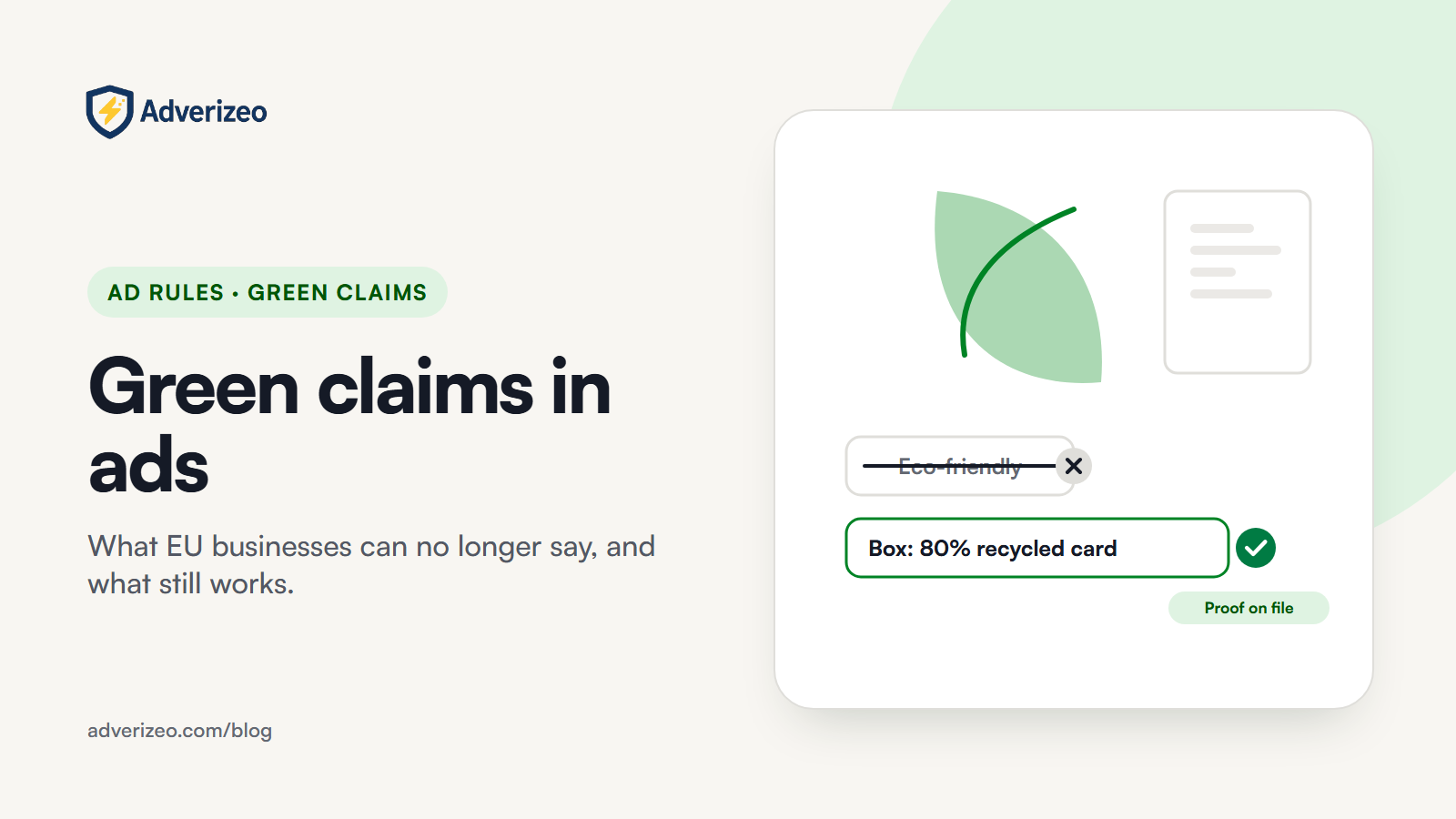
| Eco-friendly packaging | Generic claim (point 4a), the Recital 9 type of example | Shipping box made from 100% recycled cardboard |
| Climate neutral delivery | Offset-based neutrality (point 4c) and generic (point 4a) | Delivered by cargo bike inside the city centre. (Any offset funding goes in a separate company statement, never tied to the delivery.) |
| 100% sustainable fashion | Generic and whole-product claim (points 4a, 4b); "sustainable" also covers social aspects, so an ecolabel alone cannot support it (Recital 10) | Jacket shell made from 70% recycled polyester |
| Made with recycled materials (only the bag is) | Whole product, one part (point 4b) | Bag made from 80% recycled paper |
| Green energy shop | Generic claim | Our warehouse buys 100% renewable electricity under our supply contract |
| CO2-reduced coffee | Vague; banned if based on offsets (point 4c) | Our roasting now uses 30% less gas per kilo than in 2023 (measured on our meter readings) |
| Net zero by 2030 | Future claim without a verified plan (Article 6(2)(d)) | Keep only with a published plan and independent verification, and link to both |
| Our own "Eco Choice" badge on product photos | Sustainability label without a certification scheme (point 2a) | Remove it. Show only labels based on a certification scheme that meets Article 2(r) or set up by an EU public authority, such as the EU Ecolabel |
| Biodegradable phone case | Generic claim named in Recital 9 | Remove it unless you can state where, how and in what time it breaks down, with test proof |
| Plastic-free paper napkins | Likely an irrelevant benefit if comparable paper napkins are plastic-free anyway (Article 6(2)(e), judged case by case; the directive's example is paper sheets) | Drop it and use a real, distinctive feature |
One exception: certified organic food may still use "bio" and "eco" for organic production under Regulation (EU) 2018/848, the Commission's Q&A says.
7. Common mistakes
- Keeping old creatives running. Evergreen posts, marketplace listings and email footers still live are current marketing.
- Swapping "climate neutral" for "carbon positive". Both are listed in the directive's offsetting examples in Recital 12.
8. Checklist: what to do this week
- Export all live ad text and product descriptions and search for green words (eco, green, sustainable, climate, carbon, CO2, neutral, net zero, biodegradable, planet).
- For each hit, decide: specify, prove, or remove.
- Delete every "neutral", "compensated" or "reduced CO2" claim that relies on offsets. Keep offset projects, if you want, as a clearly separate statement about your contribution.
- List every badge and seal in your images. Keep only labels based on a certification scheme that meets Article 2(r) or set up by an EU public authority.
- Check that each claim names the part of the product or business it covers.
- For any target claim ("by 2030"), confirm you have a public plan and independent verification, or remove it.
- Put the evidence for each remaining claim in one folder, with dates.
- Check your national implementing law and your consumer authority's guidance.
9. What happened to the Green Claims Directive?
The Green Claims Directive is a separate proposal (COM(2023) 166, procedure 2023/0085(COD)) on substantiating and communicating explicit environmental claims. As of November 2026 it is not law. The European Parliament's Legislative Observatory still lists the file as awaiting the Council's first-reading position. In its 2027 work programme, published on 4 November 2026 (COM(2026) 710, Annex III), the Commission listed it among proposals it intends to withdraw within six months, as unlikely to win Council support. Until formally withdrawn it stays pending; the binding rules remain the UCPD changes above and national law.
For other claims, from "best" and "free" to price cuts and health, read our complete guide to advertising claims in the EU. Shops should also see the complete guide to ecommerce advertising.
Where Adverizeo fits
You can paste an existing ad into Adverizeo's free ad compliance checker, no account needed, and it highlights risky wording with a suggested fix. It is a risk check, not legal advice, so keep your own evidence for every claim. More for online shops is on our ecommerce page.
Related reading
- GDPR and AI marketing tools: what to check before you generate a single ad
- GDPR-compliant Facebook and Instagram ads
- GDPR retargeting: what EU advertisers need in place
Want ad copy you can check for risky claims before it goes live? Start free with Adverizeo.
This article is general information, not legal advice.
Frequently asked questions
Can I still call my product "eco-friendly" in an ad?
There are two lawful routes. Either you specify the claim in clear and prominent terms right next to it, on the same medium (Article 2(p) and Recital 9), and that specified claim is itself true and not misleading; or the product shows recognised excellent environmental performance relevant to the claim, for example the EU Ecolabel or an officially recognised type I ecolabel such as the Nordic Swan or Blue Angel. In practice, replacing the vague word with a specific, provable fact is the safer choice. For detergents, cosmetics, paints and other mixtures labelled under the CLP Regulation, Article 25(4) of Regulation (EC) No 1272/2008 bars words like "ecological" on the label or packaging, even with an Ecolabel, according to the Commission's Q&A.
Can I mention the carbon offset projects my business supports?
Yes. The directive and the Commission's Q&A say businesses may still advertise investments in environmental initiatives, including carbon credit projects, if this is transparent and not misleading. What you may not do is say that a product is neutral, compensated or has a reduced greenhouse gas impact because of those offsets.
Do the new rules apply to ads aimed at other businesses?
The Unfair Commercial Practices Directive, and so the new blacklist points, covers business-to-consumer practices only. Misleading B2B advertising is covered by Directive 2006/114/EC, and some Member States extend consumer-style protection to business buyers, so check your national law before relying on the difference.
Is there a grace period for packaging and stock made before 27 September 2026?
There is no general transition period. According to the Commission's non-binding Q&A, claims on existing products must comply from 27 September 2026, with fixes such as stickers or point-of-sale information. Authorities may take into account whether a business made reasonable, proportionate efforts to comply, and the national authorities in the Consumer Protection Cooperation (CPC) Network have agreed a joint "Common Understanding" on such old-stock situations.